Let’s Explore
Everyone sees the Victoria Memorial. Not everyone finds the real Kolkata.
Kolkata is one of those cities that reveals itself slowly. The famous landmarks are beautiful — but the magic lives in the lanes behind them. In a crumbling mansion that nobody visits. In a market that smells of incense and old books. In a quiet ghat where the river moves and nobody’s watching.
Here are the hidden gems that locals love and tourists almost always miss.
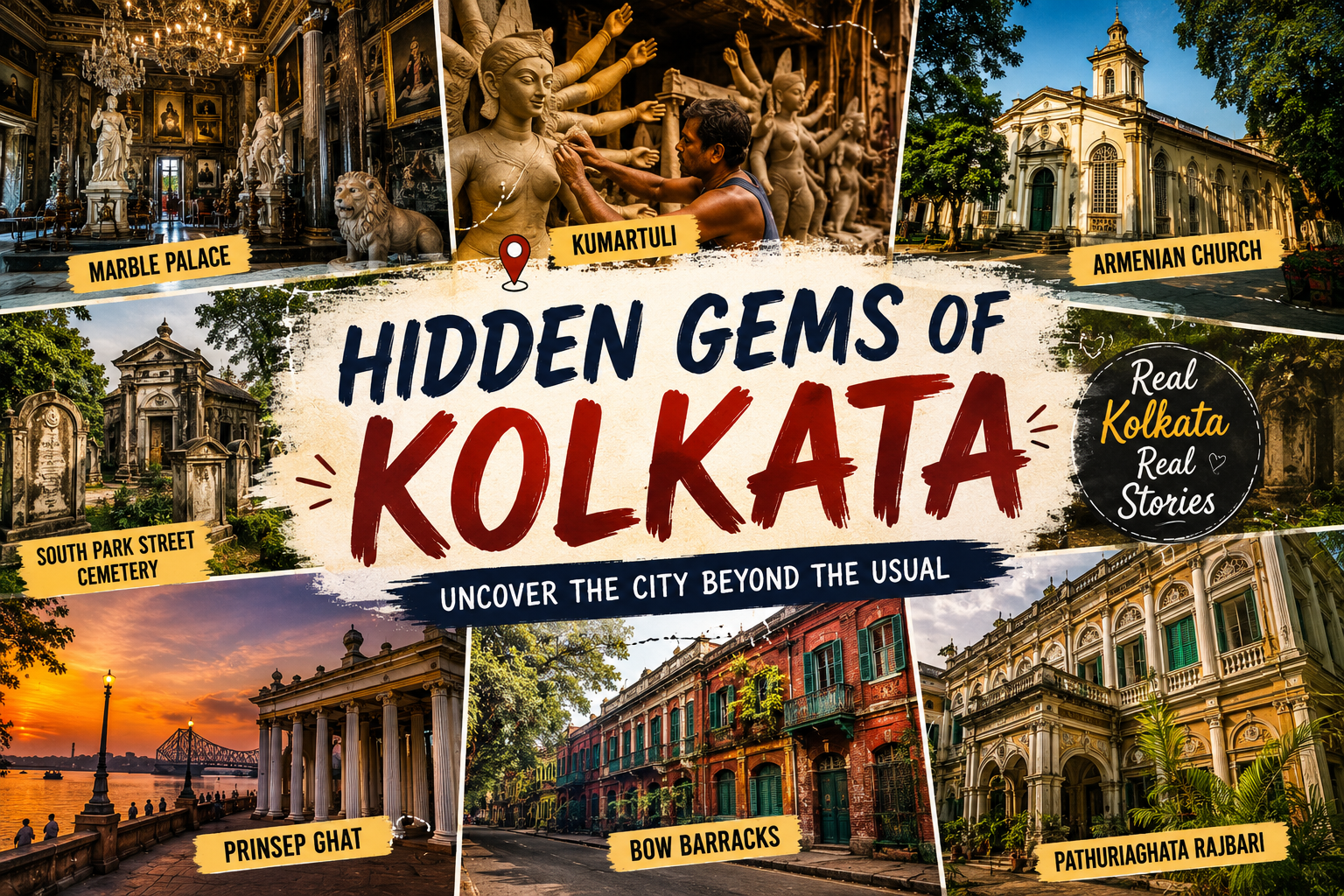
🏛️ 1. Marble Palace, Muktaram Babu Street (North Kolkata)
Most people in Kolkata have heard of it. Almost nobody has been inside.
Built in 1835 by a wealthy Bengali merchant, this private mansion in the heart of North Kolkata is one of the most extraordinary buildings in the city — a jaw-dropping mix of Italian marble floors, Belgian mirrors, Venetian chandeliers, and paintings by European masters, all inside a decaying, lived-in family home.
Entry is free but requires a permit from the West Bengal Tourism office. Worth every bit of the effort.
Area: Jorabagan, North Kolkata | Entry: Free (permit required)
⛪ 2. Armenian Church of the Holy Nazareth, Burrabazar
Hidden behind the chaos of one of Kolkata’s busiest wholesale markets is a church that’s been standing since 1724 — older than the United States.
Built by the Armenian trading community, this quiet, perfectly maintained church feels like stepping into a different century. The graveyard behind it has tombstones dating back to the 1600s. Almost no tourists come here, and that’s exactly why it’s special.
Area: Burrabazar, Central Kolkata | Entry: Free
📚 3. College Street — The Bylanes, Not Just the Bookshops
Everyone knows College Street. Few people go deep enough.
Walk past the main strip and into the narrow lanes behind — that’s where you’ll find century-old printing presses still running, tiny tea stalls that philosophers and professors have been visiting for decades, and hidden courtyards inside old college buildings that look straight out of a period film.
The famous Coffee House on the main road is iconic — but the real soul of this area lives in the streets around it.
Area: College Street, Central Kolkata | Best time: Morning
🏺 4. Kumartuli — The Potters’ Quarter
Kolkata’s Durga Puja is world-famous. Where the idols are made? Almost nobody visits.
Kumartuli is a riverside neighbourhood in North Kolkata where generations of artisans have been crafting clay idols by hand for over 300 years. The lanes are narrow, the workshops are open, and the craftsmen are happy to show you their work. Watching a ten-foot Durga emerge from a lump of clay is one of the most quietly astonishing things you can witness in any Indian city.
Area: Kumartuli, North Kolkata | Best time: Year-round (peak: August–September)
🚋 5. The Kolkata Tram — A Moving Piece of History
The last surviving tram network in India runs through the streets of Kolkata — and almost nobody takes it anymore.
A tram ride from Esplanade to Kalighat costs ₹7 and takes you slowly through some of the city’s oldest neighbourhoods. No tourist buses, no rushing — just Kolkata at walking pace, from the window of a 100-year-old carriage that somehow still runs. It’s less a mode of transport and more an experience.
Route suggestion: Esplanade to Kalighat | Ticket: ₹7
🌅 6. Prinsep Ghat — Kolkata’s Most Beautiful Sunset Spot
Most tourists go to Howrah Bridge. Locals go to Prinsep Ghat.
Built in 1843 and named after a British scholar, this riverside promenade has elegant white arches, moored country boats, and one of the finest sunset views over the Hooghly river in the city. On weekday evenings it’s quiet, unhurried, and genuinely beautiful — the kind of place that makes you fall for Kolkata all over again.
Area: Strand Road, near BBD Bagh | Best time: 5 PM–7 PM
🕌 7. Tiretti Bazaar — Kolkata’s Chinatown
Most people don’t know Kolkata has a Chinatown. Almost nobody finds it.
Tiretti Bazaar in Central Kolkata is home to what remains of the city’s once-thriving Chinese community. On Sunday mornings, a tiny lane called Chatawala Gali comes alive with pop-up street stalls selling steamed dumplings, pork buns, and congee — authentic Hakka-style Chinese breakfast that you cannot find anywhere else in India.
Get there by 8 AM. It’s over by 10.
Area: Tiretti Bazaar, Central Kolkata | Best time: Sunday, 7:30 AM–10 AM
🏡 8. Jorasanko Thakur Bari — Tagore’s Family Home
Rabindranath Tagore, India’s greatest poet, was born and died in this house. Very few people visit it.
Located in North Kolkata, Jorasanko Thakur Bari is now a museum that preserves Tagore’s personal belongings, manuscripts, paintings, and the rooms where he lived. The building itself — a sprawling red-brick mansion — is stunning. The atmosphere is hushed and reverential in a way that no ticket or guided tour could manufacture.
Area: Jorasanko, North Kolkata | Entry: ₹10 (approx) | Closed: Wednesdays
🌿 9. Chetla Lock Ghat — The Quiet River You Didn’t Know About
While tourists crowd Howrah Bridge, locals quietly sit at Chetla Lock Ghat on the other side of the city.
This small, undiscovered riverside ghat in South Kolkata has wooden boats, old banyan trees, and a stillness that feels completely removed from the city around it. It’s the kind of place where you sit for ten minutes and somehow stay for two hours.
Area: Chetla, South Kolkata | Entry: Free | Best time: Early morning or late afternoon
💬 The Real Kolkata Is Never on the Map
The best things about this city — the conversations, the corners, the sounds — aren’t listed anywhere. They’re found by slowing down, turning into the wrong lane, and letting the city show you what it wants to.
These nine places are your starting point. The rest is up to you.
— Inside Kolkata